
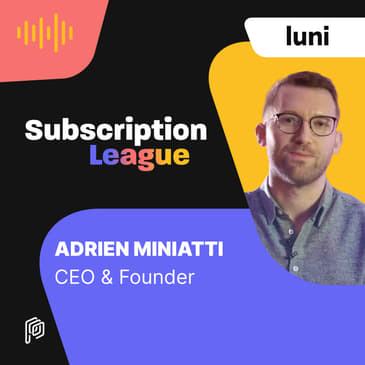
Luni’s journey as an app empire started out only about four years ago as developers of utility apps such as Scanner. Their business extended to creativity and wellness apps, including Fitness Coach(wellness), Omada(social sports betting), Meditation Nest(wellness), and Photo Studio(creativity). Luni boasts all together over ¼ million daily downloads. The company’s success is essentially based on providing gratifying app content and continuous improvement through frequent testings and optimizations. Luni is also a big advocate of influencer marketing. About 60% of Luni’s users are based in the United States.
Adrien's secret recipe for starting from scratch to reach success?
- Have a well-made application with good, fresh, and content, engaging content - it’s the basics.
- Kick off with paid traffic to gain the first user base. This will help generate data to leverage for future testings and optimizations.
- Once users start sticking around, perform frequent A/B testings on paywalls and onboardings. Use tools like Purchasley, Amplitude, and Appsflyer that allow you to achieve this efficiently.
- Build a branding strategy and gradually switch to targeting organic traffic. Also, leverage influencer marketing.
Listen to the episode to steal all the step-by-step tips for growing small apps from scratch to success!
For noteworthy quotes and key takeaways from the episode, read the article - Subscription Marketing 101: tips to drive acquisition and retention with Adrien Miniatti (Luni)
Episode Topics at a Glance
- Luni’s journey to becoming an app empire
- Apple Search Ads
- User acquisition strategy mixing organic and paid approach
- Influencer marketing
- A/B testing
- Using 3rd party tools like Purchasley
- Reasonable conversion rates to target
More about Adrien Miniatti
A passionate autodidact, Adrien Miniatti started coding at 13, recruited engineers at 19, and today spends more than 2.2 million euros per month on marketing to take the mobile applications of the Luni empire, a mobile app publisher and developer of a wide variety of applications, to the top. Adrien founded gaming studios and launched Luni about four years ago. Adrien is also an investor in several tech companies.
Adrien Miniatti’s Links
- Adrien Miniatti LinkedIn profile
- Luni website
- Luni apps on AppStore
Timestamps
00:19 Welcome and Introduction
01:05 Adrien Miniati Background
02:55 How do you approach user acquisition?
03:50 Organic User Acquisition Good and Bad
05:31 Advice for Early Start-Up
06:45 How are you building a brand?
08:25 Influencers Impact on Culture and Awareness
10:12 Converting Users to Customers with Fitness Coach
14:58 Profit and Conversion Rate
18:20 The Effect of App-Tracking Transparency
20:57 Apple Custom Code
25:09 Fitness Coach’s Development Process
30:42 Where to Learn More
Transcript
[00:00:19.560] - Olivier Destrebecq
Hey Jeff, I'm not even going to ask you how are you doing? Because I know you're doing great because we have a great guest today that you have wanted to have on the show for a long time. So why don't you introduce him?
[00:00:29.180] - Jeff
Yes, I'm very happy to have Adrien Miniatti here today. He's the founder of Luni, the famous app CEO that developed Fitness Coach, among other successful apps. As you hear, he is French as we are.
[00:00:46.370] - Jeff
Well, he has amazing successes. A quarter million downloads by day for all his apps, apps portfolio. Today, he'll tell us about how to grow a small app from scratch to success. Welcome Adrien.
[00:01:02.610] - Adrien Miniatti
Thank you. Hello Jeff.
[00:01:05.310] - Olivier Destrebecq
Adrien, after this great intro from Jeff, is there anything else you'd like our listeners to know about you and Luni?
[00:01:12.410] - Adrien Miniatti
Yes, I think you make a great introduction about Luni, but I can introduce a little myself to give some context. I'm in the mobile industry since a little more than 10 years now. I start in app marketing, and after, I build a mobile gaming studio which is called Green Panda Games, which already exist, which has been acquired by Ubisoft, I think two or three years ago.
[00:01:38.430] - Adrien Miniatti
I launched Luni four years ago now. We start with very simple application and utilities app. Simple by the way they're built, but not as simple to market. After, we say, okay, we want to address all the thematics of the App Store, so we start doing wellness, we start doing creativity because we built a lot of methods internally and we were ready to scale any kind of application.
[00:02:06.990] - Jeff
Where are your users mostly based?
[00:02:09.810] - Adrien Miniatti
In the United States. I think 60% of our users are from United States. But that's all depends on the application. For example, on utilities apps, we start very early in our app because it was easier to approach for us. Often when we start the fitness application and other wellness application, it was more profitable to do them in the United States.
[00:02:34.350] - Adrien Miniatti
As it's content application, you need to do them locally. It's not like a scanner application that the process to scan the document is the same in every country. When you are doing fitness, you need to speak in English to address English user unless they won't understand anything about your explanation and won't makes the right move.
[00:02:55.840] - Olivier Destrebecq
As you said, you have multiple apps in the store and you're doing very well on download front with over a quarter million daily downloads. Can you tell us how you approach user acquisition in your studio?
[00:03:06.510] - Adrien Miniatti
It really depends on the application because as we start with utilities was for one simple reason, just because it drive a lot of organic traffic. We do essentially use our acquisition through the App Store by paying organically, by paying through Apple Search Ads, because there is a lot of search on keyword, livescore, PDF scanner or document scanner and rewards like this, and for example, [inaudible 00:03:36] everything.
[00:03:37.620] - Adrien Miniatti
After when we start doing content application on the wellness or creativity, we start addressing more classical networks as a Facebook, Snapchat, TikTok, [inaudible 00:03:48] and Franz app.
[00:03:50.090] - Olivier Destrebecq
Most projects begins with organic user acquisition, skipping over paid acquisition. What's the good and bad about this approach in your mind?
[00:03:57.320] - Adrien Miniatti
It really depends on the project, because on utilities, for example, we have a lot of organic traffic. The good things is that we don't have to pay for anything because it's all free traffic. So it's an imagine, but it's not scalable because you have a number of users that is looking for one keyword or a project, for example, number of people that are looking for weather application.
[00:04:24.470] - Adrien Miniatti
But once you reach this maximum impression or this maximum number of users, you can't scale more because you are limited to this search volume. But after, if you build a strong brand, what we are doing for example with Omada, we really want to create a lifestyle brand that is known by all the user, you can scale your organic traffic by the reputation of your brand or your application.
[00:04:53.930] - Adrien Miniatti
For example, it was the case with Fitness Coach during the lockdown, we worked a lot with influencer. So the influencer takes the brand a lot and a lot to say okay, Fitness Coach, Fitness Coach, Fitness Coach. So you gain in reputation and you gain in organic traffic. So it brings you a lot of free traffic and as much as the brand is growing.
[00:05:21.050] - Adrien Miniatti
But yeah, it could be a trap for only utility application because you are logged by the number of traffic in the App Store.
[00:05:31.900] - Olivier Destrebecq
For early start up, do you advise them to do paid traffic, to do organic acquisition, a mix of both? Where should you stand in the early days?
[00:05:41.390] - Adrien Miniatti
I think you need both because you need to log by traffic to launch your application. To refer any on organic traffic is a little off the topic because for some people it works. You have a great application that only count organic traffic because they have a lot of featuring from Apple, but it's only maybe one app on 1,000. It's not pretty usual to contain an organic traffic even if you do utility application, but it's another topic.
[00:06:11.400] - Adrien Miniatti
You need paid traffic to launch your application, but counting only on paid traffic is very hard because paid traffic is more and more expensive because you have more and more application on the App Store, you have more and more competitors. So it's very hard to get cheap traffic and to get volume over traffic, over the price. So you need to work on your brand to have a strong brand, as I said before, to make your reputation and to get your traffic cost you less money.
[00:06:45.000] - Jeff
So would you say that building a brand is really something that is different? It's kind of a different area of marketing and product? So how today are you building a brand? I think that in your portfolio, Omada is really the app that is bootstrapping this strategy for your company. Can you tell us more about that?
[00:07:06.650] - Adrien Miniatti
Yes, for Omada, we try to do something that is more than an application.
[00:07:12.380] - Jeff
Yeah. Can you tell us—before speaking about Omada—can you tell us what Omada is for the speakers that maybe don't know yet what Omada is?
[00:07:19.200] - Adrien Miniatti
Yes. So Omada is a social betting application. So it's betting for free. But what we want to build over this is that you have the betting mechanic to retain users daily but it's more the community. People are coming from the free betting but they are staying to be with their friends, to be on the ranking, to meet some new people that are sports fans as them.
[00:07:45.300] - Adrien Miniatti
We need to work on every aspect of the application to retain the people, but also to make Omada a lifestyle brand. Now Omada, we are doing merchandising, we are doing social media, we are doing a lot of off application stuff because as I said, we want to build a brand and not just an application because it's all this population reputation that we are making in real life on social media or even around people that will make us get a lot of organic traffic and that make that our traffic is pretty cheap even if we are doing paid acquisition.
[00:08:25.140] - Jeff
Would you say that the influencers help you a lot with strapping that culture and that awareness? And would you say that this awareness is more important? Do you remain more top of mind in your customers because the acquisition was totally different?
[00:08:39.760] - Adrien Miniatti
We work a lot with influencer because this is the most efficient way to make people retain your brand. Influencer, you need to work with big influencer because influencer that will talk about your application not only once but 3, 4, 5, 6 times every week to say, "Okay, you remove member I told you about Omada, I told you about Omada, I told you about Omada," to make the brand stick in the brain of people. It's for that.
[00:09:08.950] - Adrien Miniatti
You can do this with Facebook, for example, but the guy will see the ad and that after maybe forget it. But the influencer, you trust him. So you retain more and more what they are talking about.
[00:09:22.970] - Jeff
Great. In fact, acquisition strategy change probably more of area and you need to be able to-
[00:09:30.380] - Adrien Miniatti
You need everything. But you need to [crosstalk 00:09:31].
[00:09:34.590] - Jeff
It's a secrete recipe.
[00:09:34.590] - Adrien Miniatti
Yeah, it's very hard because you need to pay the traffic to bootstrap because when you start you don't have organic, you don't have run, you have nothing. You need to have the first user that will let you to get data about your application to see if your application is doing well about retention, about engagement.
[00:09:53.930] - Adrien Miniatti
Once you see that you have a great application, that people are staying in your application, you start building your strategy to build a great brand and to generate organic traffic and to growth, growth, growth, until your traffic costs nothing.
[00:10:12.930] - Jeff
Okay.
[00:10:14.290] - Olivier Destrebecq
You mentioned acquisition using influencers, and we all know that getting the users through the door is the first step, but then you have to convert them to becoming customers, and that can be very tough. How have you approached that challenge with Fitness Coach?
[00:10:28.610] - Adrien Miniatti
Yeah, so once you generate the [inaudible 00:10:30], you need to convert your customers, as you say, because if you don't pay, so you get nothing. It's the hard thing about application.
[00:10:43.740] - Adrien Miniatti
So, yes, also in the application, it has a lot of testing. You need to do a lot of A/B testing about how you will come after your users for onboardings, for paywalls, for server things. You need to sell the value of your application to your customer even before they discover your application.
[00:11:04.770] - Adrien Miniatti
For example, you see that in every application, you have the paywall very early because it's what come out the most. To bring the paywall very early, you need to make your user understand the concept or the content of your application very early, even before the paywall. It's for that great onboarding is very important.
[00:11:25.930] - Adrien Miniatti
We were testing maybe two or three onboarding per week with several steps because we want the user not to be disappointed on the start of the trial because they will see your onboarding, they will see your paywall, which is more summary of your onboarding, and after, they will start the trial. But when they start the trial, they are not converted because they didn't pay yet.
[00:11:53.150] - Adrien Miniatti
So they need to get from free to pay, which is more complicated step because they should not be disappointed before what they saw in the onboarding, what they saw in the paywall. So you need to give the experience that you sell to the customer, which is very hard.
[00:12:12.590] - Adrien Miniatti
You don't need to be too pushy, you don't need to be too aggressive because if you say, okay, you will get this, this, this, this, they will make it on to the trial, but after they won't pay. So you will have a lot of chunk, and the chunk that is very harder to anticipate because it got free of seven days after. And after you commit him to pay, you will have the renewal. If you discover one year later that almost all your users have chunk, whereas you predict that they will stay, you will lose a lot of money.
[00:12:46.030] - Jeff
Yeah, because you have the outcome very late in the process because you have a lot of yearly subscriptions?
[00:12:52.290] - Adrien Miniatti
Yes, the trial comes the first day, so it's easy to anticipate the trial. Okay, I have 10% of my user that will get the trail, cool. But after that, those that they will pay, those they will renew after paying, which is how they stop to anticipate.
[00:13:10.270] - Olivier Destrebecq
How do you walk that fine line of not being too pushy but at the same time selling enough that you can actually sell subscriptions? What kind of KPI do you use to make sure you have that long term growth in mind and not just the short term?
[00:13:24.040] - Adrien Miniatti
I think before the KPI, the very first step is to have a great application because at the end event, you are looking to every KPI. If only you're are doing all the A/B testing you want, if you don't have a great application, people won't stay.
[00:13:38.190] - Adrien Miniatti
You need to have a good content, a well done application, an application that people love. For example, on the Fitness Coach, we invest a lot in the content while doing new video every month to keep the user engaged inside the application.
[00:13:55.870] - Adrien Miniatti
After this, the main KPI I would say is the retention because if you have a good app retention, you will have a good subscription retention and it will make... For example, one point of retention after six months, it will maybe double the [inaudible 00:14:12]. So every step over the lifetime of the user is important and every data is important.
[00:14:20.200] - Adrien Miniatti
After we use several tools to produce, for example, for subscription, we use tools like Purchasly. For A/B testing inside the application, we are using Amplitude. To see our acquisition source, we're using [inaudible 00:14:35]. We have a lot of tools over the market that make you don't need to build them from scratch, and that's that easy to put inside your application.
[00:14:46.650] - Adrien Miniatti
And after you don't have to make quality application as I said. And after you are testing your onboarding, your paywall and you try to sell your experience.
[00:14:58.630] - Jeff
Can you share with us the [inaudible 00:15:00], how many people are coming in, how many percentage are starting a trial, how many are converting at first renewal? Can you share with us maybe some generic figures that you consider are positive before [crosstalk 00:15:16].
[00:15:19.410] - Adrien Miniatti
It's [inaudible 00:15:20] question because other applications are different. For example on the Fitness application you have a lot of chunks which is normal because it's like Gym Club. You take your subscription maybe in 1, 2, 3, 4, 5 fitness application, and after you choose [inaudible 00:15:37]. So it's very hard to comment. You see people don't go to Gym Club anymore.
[00:15:42.090] - Jeff
Because they don't have a free trial.
[00:15:45.190] - Adrien Miniatti
Yeah. You pay but you don't go. So it really depends on the application. I would say a good donut to trial start at 10%. If you have 10% of people that are going from donut to trial it's cool because I think it will be the minimum to be profitable after.
[00:16:06.220] - Adrien Miniatti
But as I say, I saw some applications that have 20% because they are very specialised. For example, if you have an application for a woman that are pregnant and everything, you have higher commission because you are less general than a fitness application, for example, where you approach all people.
[00:16:27.610] - Jeff
That's a very good point. We were discussing that in a previous episode of Subscription League with Ania from Rudi. That's a panic attack specific app. She was exactly describing that specific content and how she made it profitable. So that 10% is strong and still to try.
[00:16:47.740] - Adrien Miniatti
Yeah, I think at least 10%, and after from trial to pay it's the same. I see some developers that have 60%, but I think you don't have to be less than 40, 45%. But after it also depends on your subscription duration, for example, yearly, not the same than monthly, not the same at weekly.
[00:17:13.590] - Adrien Miniatti
Weekly converts higher because it's cheaper. Some people care less, about $5 between 10 or 20, or maybe $100 if yearly. So it really depends. But I speak about monthly. If you're on monthly, I think the good KPI will be 10% and 40, 45% at least.
[00:17:37.100] - Jeff
What about [inaudible 00:17:37]?
[00:17:42.450] - Adrien Miniatti
[inaudible 00:17:42] 60% of chunk, because for example, some good application-
[00:17:54.210] - Jeff
Can you share with us [inaudible 00:17:54].
[00:17:54.210] - Adrien Miniatti
Anywhere you are in the consumer business, it's not likely to be on there. Even if you have a great application that, for example, on the yearly subscription you have only 40% of chunk, which is low for yearly subscription, it remains that 40% of the people are leaving your application, your subscription. It's pretty high. For that you need to go big to be profitable.
[00:18:20.850] - Olivier Destrebecq
How has app tracking transparency affected your business? And what did you change as a result?
[00:18:26.190] - Adrien Miniatti
Great question. It's a lot of things actually. For the work with influencer, it's okay, we work the same way with influencer. I think we work even more with influencer on Apple Search Ads piece doesn't affect a lot.
[00:18:44.610] - Adrien Miniatti
In fact it affects because all the people now are buying Apple Search Ads. Before, there is not a lot of people, and for example, we compare our numbers this year, previous, last year, I think it cost maybe four times the CPI than last year. It's crazy, all the people now are buying on Apple Search Ads because pretty. It's not easy to track, but it's easier and you can have some volume because Apple controls the traffic they deliver, so it's pretty easy to get some volume, it didn't get affected.
[00:19:18.470] - Adrien Miniatti
But where we got a lot of impact, it's on Facebook, Google and Snapchat, the big networks that need to comply with the rules, because all the networks won't comply with the rules. When you respect ATT, you need to wait maybe two or three days to get the first result.
[00:19:39.560] - Adrien Miniatti
So you'll run your ads for two or three days without seeing how much it cost. Even if MMP are doing a lot of work to make it easier, it's very hard to get a result and KPI for one specific [inaudible 00:19:56].
[00:19:57.060] - Adrien Miniatti
Now we work a lot aggregated. We need mix organic display traffic, so Facebook, Snapchat and everything on front sale. It's hard to differentiate everything, so we're working a lot aggregated on...
[00:20:14.150] - Adrien Miniatti
Anyway, when you are working with influencer, it brings a lot of organic traffic. The organic traffic has been generated by your paid traffic. It's pretty logical to get everything in the same box. But even it gets complicated to cut some networks that could perform less. But for that you need to be very organized to anticipate which campaign you will launch and which campaign could affect the quality of your traffic. You need to check even more to see two or three days after once you have your ITT the gets the bus back to see if the traffic was okay or no.
[00:20:57.670] - Jeff
You were speaking a lot about influences.
[00:20:59.870] - Adrien Miniatti
Yeah.
[00:21:01.410] - Jeff
I have one question because Apple released something that's called Custom Code that basically allow you to bring specific code that could be delivered by influencers and maybe let you know better the source for a specific subscription. Have you tried these strategies already at Luni?
[00:21:21.280] - Adrien Miniatti
We tried maybe at the beginning, but it was very early for the project so it didn't work very well. It was very hard to explain them how to type the code or it worked and everything. They were saying, "No, it didn't work and everything." It's not an easy process for influencer and even more for the customer. So for now we don't use it a lot. We are waiting that the system improved.
[00:21:50.950] - Jeff
I hope that they're going to bring-
[00:21:53.390] - Adrien Miniatti
It's already improved, but not at 100%. As I said you have a lot of traffic [inaudible 00:22:00] type Fitness Coach on the App Store things [inaudible 00:22:11] but the real trial and after the paid they paid they say, "Okay, why pause the card, it's too late."
[00:22:16.730] - Olivier Destrebecq
We've talked a lot about KPIs and what to monitor and the fact that you want a great application to retain your customers. I want to ask you more about subscription because we know that getting subscription right is tough. Do you have any advice that you can share on how to get subscription right in your app?
[00:22:34.270] - Adrien Miniatti
It's a weird question because it really depends on the application. The first step before putting subscription is to think about which part of your product you will monetise to bring value to the user because it's a subscription, so user will pay every month or every week. You need a content that is refreshed every week or every month. For example, you see this a lot on creativity. For example, you have new template, you have a new way to make your picture and everything, so you need to think a lot about the value you can bring to the user because subscription could be very expensive for the user and that that will lower your charm.
[00:23:20.900] - Adrien Miniatti
After that, as I said previously, you need to explain to the user this value during your onboarding, you're in your paywall, and for this you can start with very easy version. You have a lot of reference and gallery over the internet. You see all the paywall of every application, so you can just get inspired by your competitors or by top grossing of the App Store and to put the first paywall to event for the onboarding to work on it and after. Also you have your subscription bit inside the application. You start testing your onboarding, your paywall to test the message.
[00:24:04.410] - Adrien Miniatti
After you get the right message, you get the right commercial, you can test different pricing, different trial period. It's very important because it could also depend on the country you're advertising on. For example, in the United States, they may be willing to pay for yearly subscription, which is not the case in France or in Italy because they need a lower price, so they may need a weekly subscription.
[00:24:32.290] - Adrien Miniatti
It's as important to work on commercial but also on pricing because it could affect the commercial. But doing the both at the same time will be too harder because you will test several things. You won't see the proper results.
[00:24:51.690] - Olivier Destrebecq
Yeah, that's something that we hear from a lot of people. Test one thing at a time so you can clearly interpret the results.
[00:24:57.830] - Adrien Miniatti
But I think the first thing is to test the message because it's what you will say. And you have a good conversion, you can test the price and everything because you have a good base.
[00:25:09.470] - Olivier Destrebecq
In your studio, you start by taking an app idea and you make it into minimum product, test it, iterate and see if the results are correct for your investment. Can you tell us, I'm curious about the story of Fitness Coach and how that applied to Fitness Coach?
[00:25:25.980] - Adrien Miniatti
Yes, so it was exactly the method I talked previously when I said you start with paid traffic. In fact, Fitness Coach, we made maybe four version of the application.
[00:25:38.670] - Adrien Miniatti
At Luni, when we tried new category, we don't want to exceed two months of development because we wanted to try very quickly a product-
[00:25:57.150] - Olivier Destrebecq
That's both iOS and Android?
[00:25:57.150] - Adrien Miniatti
On the iOS to start because it's where the money is. For example, in Fitness Coach, the very first application, the name wasn't even Fitness Coach. It was another name, I don't remember, maybe Work Out Now, I don't even remember. But we made the first application.
[00:26:14.910] - Adrien Miniatti
We tried to work on the product. We see the retention, we say, "Okay, it's not a good engagement, it's not a good retention." I said previously, the very first step is to work on the product and to bring paid traffic and to see if your user engage with the app.
[00:26:31.510] - Adrien Miniatti
We made the second version, it was better, but not enough. We made the third version and we say, "Okay, who has the good receipt?" So we start testing paywall and we see there were great willingness to pay. I think maybe we try two or three times of the paywall or so. Each time, maybe two or three months of iteration.
[00:26:52.270] - Adrien Miniatti
We start working on a Fitness app. I say Fitness app because it was not Fitness Coach, maybe in April, and we released proper version in December. So, free iteration of two months globally.
[00:27:08.570] - Adrien Miniatti
After we get the good engagement, the good retention and the good commercial and the paywall, we start, as I said before, doing the brand. So working on the brand, we start working with [inaudible 00:27:21], we start testing different onboarding, testing different paywall.
[00:27:26.230] - Adrien Miniatti
We scale one day to another. We say okay, we are profitable, we have good metrics, so now we can scale. We were spending one [inaudible 00:27:34] in a month, so from what date, it was not there.
[00:27:38.910] - Jeff
At any moment of this process, do you have your mind to, okay, "Maybe I can kill the project because it will never be profitable?"
[00:27:47.320] - Adrien Miniatti
For fitness, it was pretty particular because previously we killed a lot of projects which were more niche or more specific, for example, sleep application or maybe creativity application. A lot of different application that we killed because we didn't get the good metrics.
[00:28:08.350] - Adrien Miniatti
But as there were no reference on the App Store, we said okay, maybe there's just no market. Once you have the good metrics, you need to scale. We got project with very good metrics, but once we start doing paid acquisition, we said, okay, it will be too hard to pass the message or it will be too hard to get a lot of traffic.
[00:28:33.990] - Adrien Miniatti
As I said, you have a lot of chunk on the consumer subscription, so you need to scale a lot to make a lot of money. And the other side, there is not a lot of application that is making hundreds of millions per year. There's only maybe five or 10 applications that are doing this, which are calm and-
[00:28:57.850] - Jeff
Dating apps.
[00:28:57.850] - Adrien Miniatti
Yeah, dating apps mainly, but you don't have a lot of applications that are making hundreds of millions per year. We saw maybe sometimes that we don't have the ability to scale or maybe don't have just good metrics, so we keep them.
[00:29:10.960] - Adrien Miniatti
But on fitness, we know that we're actors that were profitable and we know that you have a big market, so we say, "Okay, we just need to find out." It was a different approach from what we did before, because you say. "Okay, we know that there is a market. We know that there is a lot of fitness app and that are making a lot of money."
[00:29:33.470] - Jeff
You were willing to spend more time to [crosstalk 00:29:35].
[00:29:35.770] - Adrien Miniatti
For that you say, "Okay, there's a way." We achieved to crack it, and after, yeah, it's been two years that we are the most honored fitness app on the US App Store. Thanks to this work, to iteration, iteration, and after once you iterate and you have good metrics, you need to spend a lot to get your reputation, to get your organic traffic and to make the magic happen.
[00:30:03.370] - Adrien Miniatti
No matter, it's very different because we get another approach, again. It was something that didn't exist on the App Store. There was no successful social betting application, so we launched a different concept and we say. "Oh, there's a great engagement, there is now some retention." So we say, "Okay, sports is a busy market. Betting is a huge market." So we say, "Okay, we can scale, we have a huge engagement, so we need to scale it and to maintain it."
[00:30:37.380] - Olivier Destrebecq
Great. Those are all great stories. It's great to hear how you guys go from the beginning to bigger success stories.
[00:30:43.230] - Olivier Destrebecq
This is the end of the time that we had to chat with you today. If our listeners want to learn more about you and Luni, where can they go?
[00:30:52.630] - Adrien Miniatti
You can go on LinkedIn or maybe, yes, mainly LinkedIn. They can contact me, and I will answer.
[00:31:14.390] - Jeff
On Luni [inaudible 00:31:14] also?
[00:31:14.390] - Adrien Miniatti
Yeah, Luni, That app is not direct to me. Every kind of profile, marketing everything. As soon as you're working at the app industry, we are hiring.
[00:31:24.860] - Jeff
Paris only, Paris, Bodo, maybe other place?
[00:31:29.370] - Adrien Miniatti
Paris, Bodo and the United States, but more for Omada.
[00:31:31.870] - Jeff
Thanks for sharing with us today.
[00:31:33.350] - Olivier Destrebecq
Awesome.
[00:31:33.420] - Adrien Miniatti
Also, thank you for listening to me.
[00:31:35.780] - Olivier Destrebecq
Thank you so much for joining us today, Adrien. Those were some really awesome answers that you got, and our listeners will really benefit from the experience you brought on our podcast today. So thanks again.